
Businesses that spent years fighting for page one of Google are now watching their click-through rates fall despite holding those positions. The reason is not a penalty or an algorithm change in the traditional sense. It is that AI Overviews are answering the question before a user ever scrolls to the results.
In 2026, AI search optimisation has fundamentally changed how businesses get found online, the traffic that once flowed from ranking well is being intercepted at the top of the page by a generated summary that cites its own sources. This is the structural shift that defines search in 2026. Getting found online no longer means simply ranking; it means being cited by an AI system that synthesises the answer. Those are two very different problems, and they require different thinking to solve.
At SABR, we have been running AI search visibility audits with clients since early 2025, and one pattern is consistent: the businesses appearing in AI-generated answers are not necessarily the ones with the highest domain authority. They are the ones whose content is structured to be extracted, attributed, and trusted. This article covers what that means in practice, from the technical foundations your site needs to the content formats AI systems favour, the schema markup that builds credibility, and the ways you can track whether any of it is working.
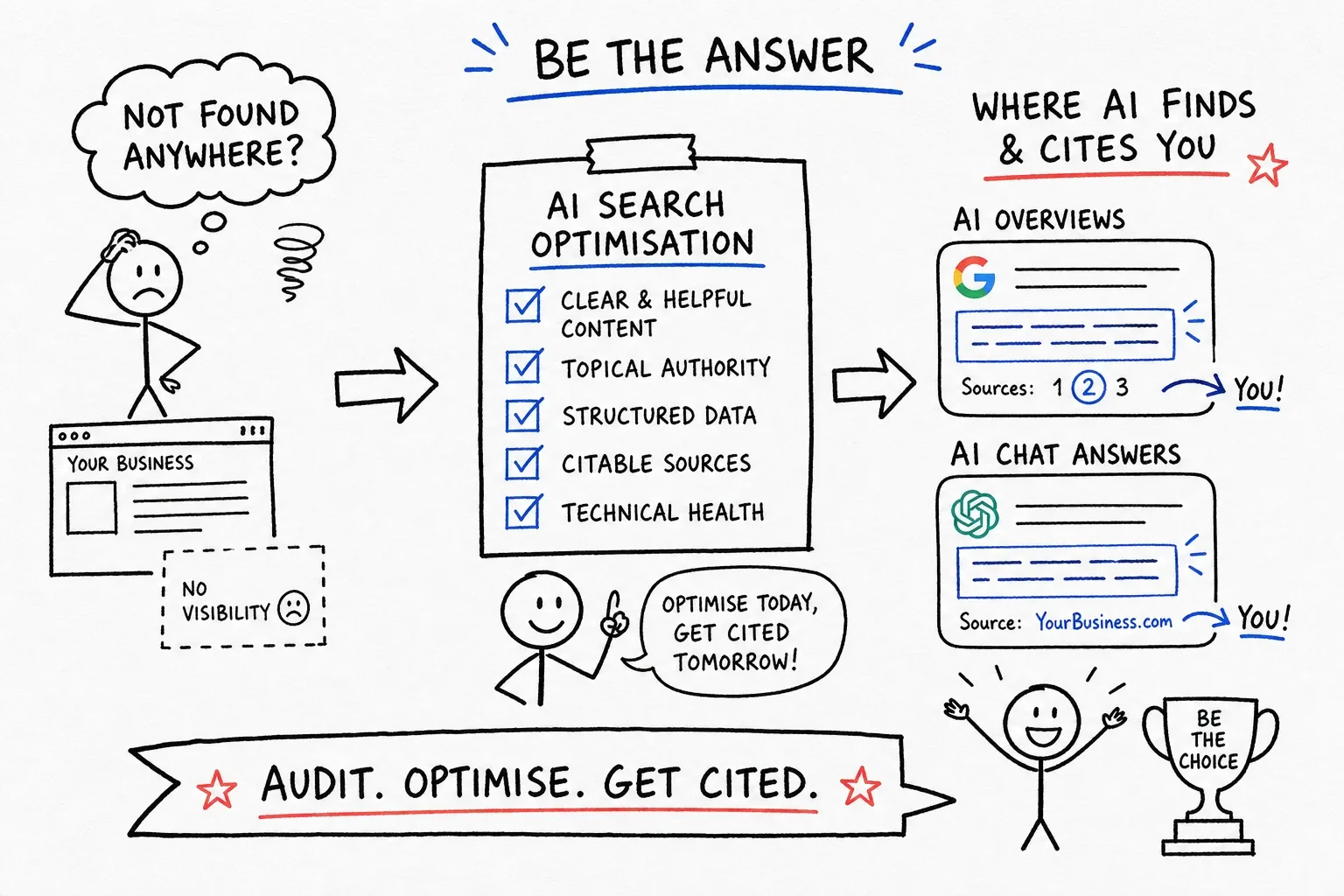
What "getting found" means in an AI-first search landscape
Google AI Overviews, which rolled out broadly through 2025 and into 2026, along with conversational tools like ChatGPT Search and Perplexity, now answer many queries with a synthesised response rather than a ranked list of pages. A user searching "best digital strategy for a growing business" may read a four-paragraph AI-generated answer and close the tab without visiting a single website. The zero-click problem that SEOs have tracked for years has expanded significantly.
Importantly, this does not mean traditional SEO is irrelevant. AI search optimisation sits as a layer on top of conventional practice, it is not a replacement for it. A page can rank in position one and still be ignored by Google's AI Overview if it lacks the right signals. The distinction matters because the fix is not the same in both cases.
There are now three distinct places a business can appear in search: traditional organic results, Google AI Overviews, and third-party AI tools such as ChatGPT, Perplexity, and Microsoft Copilot. Each has its own selection logic, and appearing in one does not guarantee appearing in another. A complete AI content discoverability strategy needs to account for all three.
How AI systems choose which sources to cite
Google's official guidance, published in May 2026, confirms that E-E-A-T (Experience, Expertise, Authoritativeness, Trustworthiness) remains the core selection filter for generative AI search ranking. AI systems prioritise content with clear author attribution, a demonstrated point of view, and original perspective. Content that restates what every other page in the niche already publishes gets skipped, regardless of how well it ranks.
The same guidance explicitly flags a set of tactics as ineffective: content chunking designed to manipulate AI responses, keyword stuffing aimed at generative search, and llms.txt hacks. These approaches do not improve citation rates and can signal low-quality intent to Google's systems. There is no shortcut.
What does work is content that is self-contained, factually verifiable, and structured to answer a specific question directly. Businesses with broad, general-purpose content are being skipped even when their backlink profiles are strong. The clearer and more specific your expertise is on a given topic, the more likely an AI system is to surface it as a reliable source. Vagueness is the visibility killer in this environment.
AI search optimisation: Technical foundations your site must have
The fastest, most immediate fix available to most businesses is checking whether they are accidentally blocking the AI crawlers that decide citation eligibility. GPTBot, PerplexityBot, and ClaudeBot follow standard web crawling protocols, which means a blanket Disallow rule in your robots.txt file will cut them off entirely. Many sites have exactly this configuration in place without realising it.
JavaScript rendering is the next major barrier. Most of these bots do not render JavaScript, which means any content loaded dynamically is invisible to them. If your pricing pages, case studies, or service descriptions only appear after JavaScript executes, those pages effectively do not exist for AI indexing purposes.
Beyond crawler access, the following technical checks form the baseline audit every site should run:
robots.txt audit: confirm GPTBot, PerplexityBot, and ClaudeBot are not disallowed
JavaScript rendering check: disable JavaScript and verify critical content still appears in raw HTML
Sitemap health: remove redirected URLs and low-value pages that waste crawl budget
Canonical review: ensure canonical tags point to the correct primary URLs and no duplicate versions are being indexed
Indexing directives: confirm that any page intended for AI citation carries no noindex tag
Content structure for AI search optimisation: Earning a place in generated answers
AI systems are built to extract direct answers. Content that buries its response in several paragraphs of preamble gets passed over in favour of content that answers the question in the first one or two sentences of each section. This is the inverted pyramid applied rigorously: put the answer up front, then provide supporting context. Writing that builds to a conclusion is the wrong format for AI content discoverability.
H2 and H3 headings written as questions, or that directly mirror how users phrase their queries, help AI systems parse which section of your page answers which prompt. This is not a stylistic choice; it is a structural signal. A heading like "How do I reduce my business's dependence on paid ads?" is far more useful to an AI extraction system than "Our approach to organic growth."
The content formats that AI systems favour most consistently include:
Short, factual paragraphs where each section can stand alone as a self-contained response
Original data and proprietary research, AI cannot fabricate these, so they act as source anchors
FAQ sections with concise, snippet-style answers
Listicle formats, in our AI search visibility audit work, these appear disproportionately in ChatGPT citations, likely because they map cleanly to process-oriented answers
Dense, flowing prose is harder for AI indexing agents to extract reliably, regardless of how well-written it is. If your content is currently structured around long-form narrative, restructuring key sections into these formats is one of the most direct improvements available to you.

The schema markup that signals trust to AI systems
FAQPage schema has the highest citation probability among all structured data types when it comes to optimising content for generative AI. AI platforms frequently pull FAQ content verbatim into generated answers because the format directly mirrors how users phrase prompts and how AI tools structure responses. If you are only going to implement one schema type, FAQPage content is where to start. Note that while Google formally deprecated FAQPage and HowTo rich result features in early 2026, the underlying structured data still functions as an AI citation signal; the Question/Answer and HowToStep formats retain their effectiveness.
Article and BlogPosting schemas should always include date published, date modified, and a linked author attribution. These properties pass freshness and credibility signals that AI systems use to assess whether content is current and authoritative. Author schemas build E-E-A-T at the page level, helping AI attribute expertise to an individual contributor rather than treating the content as anonymous.
One underused but practical signal is SpeakableSpecification within BlogPosting schemas. This marks specific paragraphs, such as a short summary or key takeaway block, as suitable for AI extraction. Organisation and Person schemas with sameAs links to LinkedIn, Wikidata, or Crunchbase help AI systems verify and consistently reference your brand as a trusted entity. Structured data for AI citations works precisely because these entity signals tell an AI system that your business is a real, established source rather than an anonymous publisher.
Measuring your AI search visibility (and why it is harder than it sounds)
Standard analytics do not capture AI-generated impressions. When Google AI Overviews or Perplexity synthesise your content into an answer, no click is sent to your site. The user gets what they need and moves on. This means a page can be cited repeatedly in AI responses while its traffic metrics show nothing unusual, or even a decline.
That decline is actually one of the most reliable indirect indicators available. If a page continues to rank well in traditional organic results but its click-through rate is falling consistently, AI is almost certainly summarising that content rather than sending users through to read it. Google Search Console does not yet provide direct AI Overview impression data for most properties, though this is beginning to surface in some accounts.
Manual testing remains the most reliable current method. Here is a practical process to follow:
Identify five to ten target queries that matter to your business
Search each query in Google, ChatGPT Search, and Perplexity, note which sources are cited and how they are referenced
Check whether your site appears, and if not, identify whether a competitor's content is being cited instead
Cross-reference what you find against your robots.txt configuration, JavaScript rendering, schema implementation, and E-E-A-T signals
Watch for the key indirect signal: falling click-through rate on pages that retain strong traditional rankings
For businesses that want a systematic rather than ad hoc approach, working with a strategic partner to run a structured AI search visibility audit is considerably more efficient. Reviewing existing content, technical setup, and entity signals together prevents surface-level fixes from missing the deeper structural issues that actually determine whether AI systems cite you or skip you.
Building AI search optimisation into your ongoing strategy
AI SEO in 2026 is not a separate discipline to layer on top of everything else. It is an evolution of good practice: credible content, clean technical foundations, and clear expertise signals. The businesses that treat it as a one-time technical audit will see initial improvement followed by stagnation, because the AI systems making these selection decisions continue to evolve.
The action sequence is clear: audit technical access for AI crawlers, restructure content to answer questions directly and specifically, implement the right schema to signal trust and entity legitimacy, and monitor indirect visibility signals rather than waiting for direct attribution tools that do not yet exist.
Businesses that build this thinking into their ongoing digital strategy will compound their advantage over time. Those that ignore it will find themselves ranking on page one for queries where the actual answer is being delivered by someone else.