
An organic growth strategy is the most reliable way for SMEs to build lasting visibility that outlives paid campaigns. We hear the same story from business owners across Ireland and the UK all regularly: Google Ads running, maybe Meta campaigns too, traffic coming in, then the budget gets cut or reallocated, and the traffic disappears with it. There is no residual value. No asset left behind. Just a hole in the pipeline and a rising cost to refill it.
In our experience working with SMEs, the same pattern surfaces repeatedly: plenty of activity, not enough strategy. Channels operating in isolation, budget chasing short-term results, and no sustainable engine underneath. Building a proper organic growth plan fixes that and this article breaks down what that actually looks like, why the numbers support it over a realistic 12 to 24-month horizon, and how to start without needing a full in-house team to pull it off.
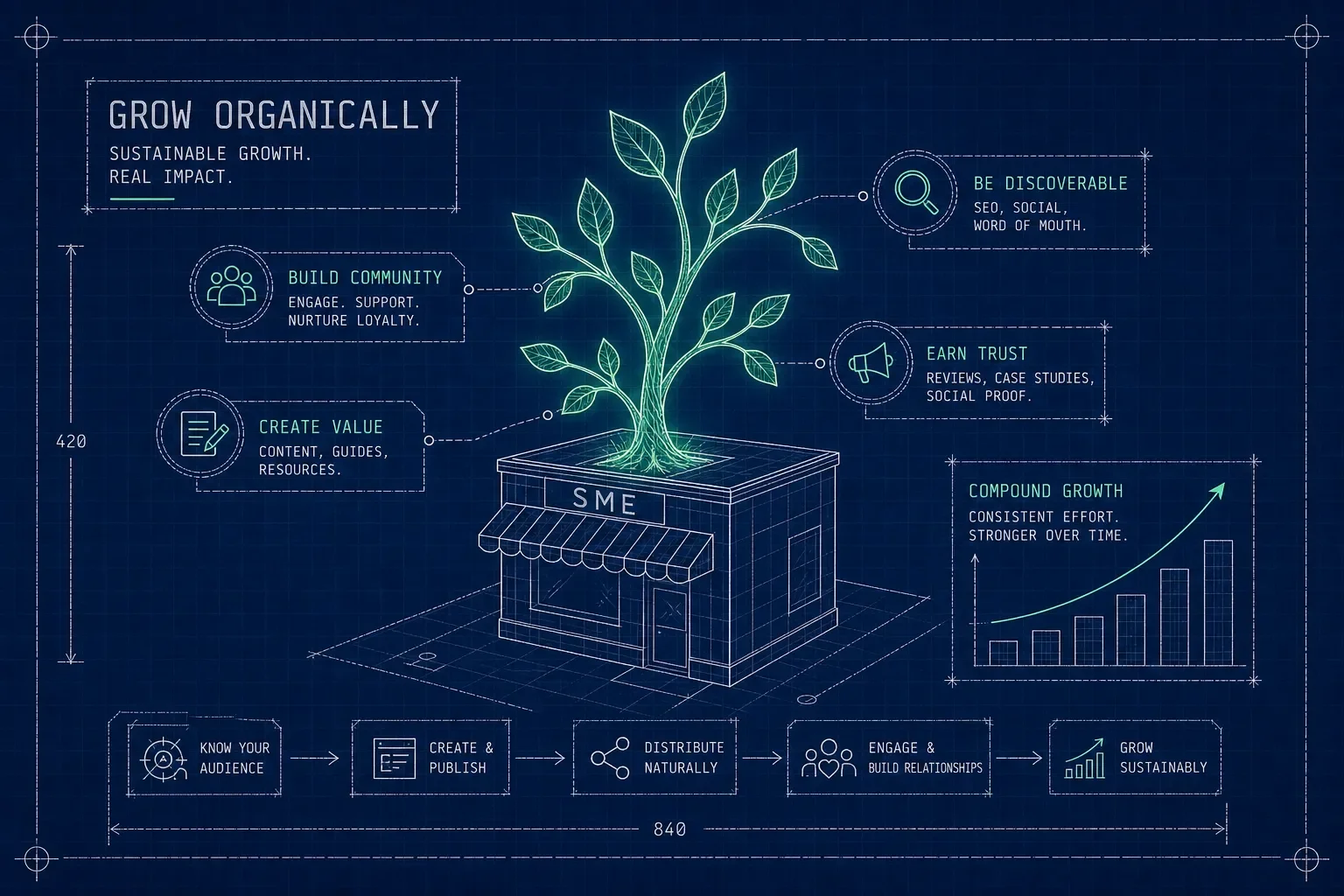
What an organic growth strategy actually is (and what it isn't)
Organic growth means growing your revenue, traffic, and customer base through internal effort: SEO, content, product improvements, referrals, and retention. It is not about acquisitions, or about paid media, and not about external partnerships designed to generate short-term spikes. The compounding effect is what separates it from everything else. Each asset you build, whether a well-ranked article, an email list, or a referral system, keeps working after the initial investment.
Organic vs. inorganic growth: the core distinction
Inorganic growth relies upon external events to generate momentum: a paid media campaign, an acquisition, or a funding round that allows aggressive market spend. Organic growth compounds from within. The Ansoff Matrix gives a clean way to frame the four paths available: market penetration (selling more to existing markets), product development (new offerings for existing customers), market development (entering new markets with existing products), and diversification. For most SMEs, the first two are where organic efforts deliver the fastest return before expanding further. For useful frameworks and perspectives on building stronger business performance from internal growth, see insights on organic growth from Simon‑Kucher.
When organic is the right choice for your business
An organic-first approach makes the most sense when your monthly ad budget is constrained, your business has been operating for at least 12 months with a defined audience, and your buyers research before purchasing. The third condition, research-led buyers, carries the most strategic weight. For B2B service businesses, professional services firms, and SaaS companies across Ireland and the UK, all three conditions are typically present. The buyer's journey typically involves Google searches, comparison, and validation, which is precisely where a well-executed organic growth strategy intercepts existing demand.
Why organic outperforms paid ads over time for SMEs
The business case for organic is not theoretical. It is a straightforward unit economics argument that plays out over a 12 to 24-month window, and the gap between organic and paid widens as the strategy matures.
A blog post or optimised service page that reaches page one of Google continues generating traffic and leads for months or even years after publication. HubSpot achieved a 3.5x increase in organic traffic within one year through consistent investment in educational content, an asset that keeps paying back long after the work is done. A paid ad stops the moment the budget does. The mental shift required is treating organic content as infrastructure rather than expenditure. You are building something you own, rather than renting visibility from a platform that adjusts its prices and algorithms at will.
The real cost comparison: organic acquisition vs. paid
Current benchmarks place the average cost per lead from organic SEO for B2B businesses at approximately £25-£29, compared with £53-£91 for Google Ads B2B leads, with competitive sectors such as financial services and HR technology running considerably higher. As your organic content matures past the12-month mark, your cost per organic lead continues to fall while paid costs remain fixed or increase as competition intensifies. For SMEs operating with constrained budgets, this difference in unit economics is material. Organic wins on LTV:CAC once the strategy has had time to establish itself.

The three pillars every organic growth plan needs
A functioning organic growth strategy is not a loose collection of tactics. It rests on SEO, content, and a disciplined channel mix, three elements that reinforce each other. Weakness in any one of these limits the effectiveness of the others. For practical, tactical guidance on implementing these pillars, our top strategies for boosting organic website traffic outline high-impact actions for SMEs.
SEO as the foundation for sustainable visibility
Organic search captures demand that already exists. Someone is already searching for what you offer; the question is whether your website is the one they find. A working SEO foundation for an SME means pages that target the right search terms and content that answers what prospective customers are genuinely asking. Core Web Vitals, specifically loading speed, interactivity, and visual stability, are direct ranking factors confirmed by Google. Ignoring technical health undermines every piece of content you publish on top of it.
Content that attracts and converts the right audience
Content is how SEO rankings translate into actual leads. The most effective content for SMEs is answer-led: it addresses the specific questions buyers are asking during the research phase and quality matters more than frequency. A single well-researched article targeting a specific buyer question at the right stage of the funnel outperforms ten generic posts that attract casual traffic with no purchase intent. For B2B in 2026, gated research reports, comparison guides, and ROI calculators are often among the highest-converting formats for organic channels. If you're wondering about timelines, expectations around ranking and visibility are covered in detail in analyses of how long it takes to rank on the first page of Google.
Matching your channel mix to your audience
Organic does not mean Google-only. Depending on your business, the right channel mix might include things like LinkedIn content, an email newsletter, YouTube, or even podcast appearances. The discipline is choosing two or three channels where your target audience actually spends time, then executing consistently on those rather than spreading effort across six channels and doing none of them well. Spreading too thin is one of the most reliable ways to stall an organic growth strategy before it has a chance to compound.
The tactical levers that drive organic revenue growth
Once the foundations are in place, the question becomes which levers to pull first. Not all levers are equal, and the order matters.
Most SMEs chase new customers before optimising what they already have. Retention is the most capital-efficient lever available. Research from Bain & Company found that a 5% increase in customer retention can lift profits by 25-95%, far exceeding the return from equivalent investment in new acquisition. Pricing sits alongside retention as the highest-leverage action a business can take: a McKinsey study found that a 1% price increase translates to an 11.1% increase in operating profit on average. Both levers should be reviewed and tightened before any new organic acquisition channel is added. Getting more value from existing customers costs a fraction of what it takes to replace them.
Referrals, product-led growth, and content loops
Once your customer retention strategy is healthy, referral systems become the most cost-effective way to grow your customer base organically. The key is actioning referrals at moments of peak customer satisfaction, not as an afterthought or ad hoc request. Product-led growth works when the product or service itself becomes a growth driver: users return, recommend, or share without prompting. Content loops tie this together by giving satisfied customers something genuinely worth sharing, a useful guide, a diagnostic tool, or a well-timed email sequence that addresses the next problem they face.
Executing an organic growth strategy without a full in-house team
This is where most SMEs get stuck. The strategy makes sense. The logic is clear. Execution is where it breaks down, and it breaks down for a consistent reason.
An organic growth strategy requires consistent content production, technical SEO oversight, analytics interpretation, and channel management. Without someone senior enough to make strategic decisions and hands-on enough to implement them, activity stays disconnected from outcomes. Hiring a full-time digital director or CMO in Ireland costs upwards of €125,000 in base salary before benefits and overhead, unnecessary for most businesses at the SME stage. Many traditional agency arrangements deliver outputs without the strategic depth or adaptability an internal growth strategy demands, leaving execution fragmented.
The embedded partner model in practice
Consider a typical scenario: an Irish B2B services business generating €1 to €2 million in revenue, relying on referrals and occasional paid ads, with no structured organic strategy and no clear picture of what is driving inbound enquiries. They engage SABR as an embedded strategic partner. The first quarter covers a digital baseline audit, a 12-month organic growth roadmap, and the technical and content foundations. In cases like this, organic search typically begins generating qualified leads within six months, and for clients who sustain the approach, it becomes the primary lead source well within 18 months. The cost of that engagement typically runs between €30,000 and €60,000 annually, compared to €125,000 or more for a full-time senior hire, with senior strategic input at every stage rather than work delegated to a junior account team. That is the SABR model: senior thinking embedded in the business, without the overhead of a permanent hire or the disconnection of a conventional agency retainer.
Measuring your organic growth strategy: KPIs and realistic benchmarks
Tracking the right metrics is what separates a strategy from a guess. Most businesses optimise for the metrics that are easiest to report rather than the ones that connect to actual revenue. For a helpful list of the most relevant metrics to track, consult guidance on essential SEO KPIs.
Visibility and traffic metrics worth monitoring
Organic traffic volume, keyword rankings (tracked alongside impressions and click-through rate, never in isolation), and engagement time are the core visibility signals. For SMEs in the early stages of building an organic strategy, the target within 12 months is steady month-on-month growth across at least two consecutive quarters. Seed-stage benchmarks of 1,000 to 5,000 monthly organic visitors are a realistic initial target. Early momentum matters: Ahrefs data indicates that roughly 40% of pages reaching top-10 positions do so within their first few months of publication, which means publishing quality content promptly rather than waiting for perfection.
Conversion and pipeline metrics that prove ROI
Organic traffic without conversions is not a growth strategy. It is a vanity exercise. The most revealing metric is organic LTV:CAC: it compares the lifetime value of customers acquired through organic channels against the cost of generating that traffic. For B2B businesses specifically, the traffic-to-MQL (marketing qualified lead) ratio matters more than raw visitor numbers. A page drawing 3,000 monthly visitors and producing 30 MQLs outperforms one drawing 30,000 visitors and producing 15. Pipeline attribution tracking becomes meaningful once you are generating more than 50 organic leads per month; before that, focus on micro-conversions such as email sign-ups and content downloads.
The case for starting now
An organic growth strategy is not a nice-to-have for SMEs working within budget constraints. It is the most sustainable path to scalable revenue available to them. The compounding nature of SEO and content means that the work done this quarter keeps generating returns next year and the year after, something paid media cannot replicate. The key is building on the right foundations in the right order: technical SEO health, quality content targeting real buyer questions, a disciplined channel mix, and then retention and pricing tightened before piling on new acquisition channels.
Execution is where most businesses stall, and the reason is almost always a lack of senior strategic resource, not a lack of willingness. Access to that thinking does not require a full-time hire. If building a sustainable organic growth engine feels like the right direction but the path forward is not yet clear, a focused strategy session with SABR is a practical place to start. One conversation is often enough to identify exactly where the gaps are and what to fix first.